by
Kasirim Nwuke
Addis Ababa, Ethiopia
I only recently learned of the death of the prominent Ghanaian economist Prof. George Ayittey. The news reached me through a publication shared with me by a Ghanaian friend. I have since confirmed that he died in January 2022. George was an associate professor of economics and later Distinguished Economist in Residence at American University in Washington, DC. George became famous in the 1990s, the decade of Afro-pessimism that culminated in February 2000 with The Economist magazine’s front cover story on Africa titled “The Hopeless Continent.” He was known for his use of very provocative, and quite often incendiary and derogatory language to describe the state of African affairs at the turn of the century. Many non-Africans (and some Africans) liked what he was saying and how he was saying it. But most Africans I knew understood that Afro-sensationalism—by which I mean the habit of Western media and commentators to magnify negative news about Africa while not giving equal attention to positive news—did not represent the full spectrum of Africa’s truth and reality. Requiescat in pace.
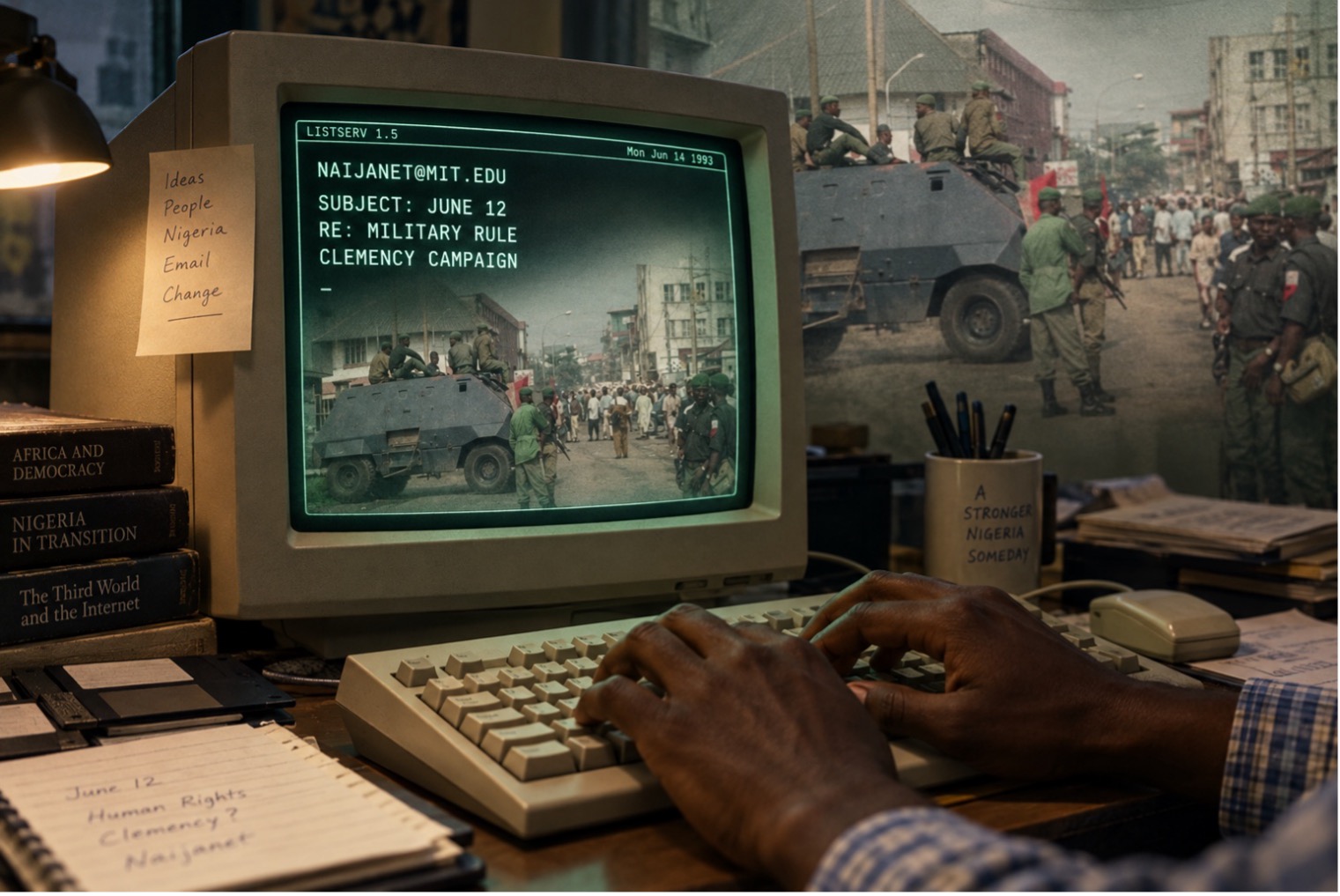
This essay is not an obituary, not a settled history. It is a recollection, albeit an incomplete one, of a particular moment in time. It is the 1990s, the years of struggle against the military dictatorship of General Sani Abacha in Nigeria, and how Nigerian intellectuals in the diaspora contributed to it; it is a remembrance of a time when an early Internet technology, the listserv, enabled the creation of a platform, Naijanet, that made the diaspora’s active participation possible. The remembrance was instigated by the belated arrival of the news of George Ayittey’s death.
Prof. Ayittey and I met in 1998 or thereabouts—not in person but on Naijanet. For those who do not know, Naijanet (naijanet@mit.edu), one of the earliest electronic mailing listservs, was created in 1991 by Dayo Ogunyemi, then a young Nigerian MIT freshman. It was the second Africa-focused listserv hosted by MIT—the first being KenyaNet (KenyaNet@mit.edu) which was launched in 1989. It grew out of an earlier Nigeria-focused email (distribution) list that was circulated out of Dartmouth College among Nigerian undergraduates in U.S. Ivy League schools and was later expanded to other universities. There will be more on Naijanet in a subsequent essay. Suffice it to say that Naijanet, perhaps to the surprise of its founders, soon became the leading electronic “Village Square” (as “Naijaneters” fondly called it) and arena, long, long before social media, where Nigerians in the diaspora hungry for news from home went to, met each other, made new friends (and new enemies too) and engaged in passionate debates on pressing national issues.
Regrettably, the 1993 election result was annulled by the then military president, General Ibrahim Babangida, and the result was never officially announced. An interim civilian administration, headed by Abiola’s Egba kinsman, Ernest Shonekan, succeeded the Babangida administration. General Abacha overthrew it in November 1993, further complicating the political situation. In June 1994, the presumed winner of the election, Mr. M.K.O Abiola, declared himself president. The Abacha administration arrested and charged him with treason and kept him in prison indefinitely. This drove many of Abiola’s supporters into exile. A number of Abiola’s supporters came to Naijanet hoping to recruit supporters for their cause. This turned Naijanet into the intellectual hotbed of opposition not only to the annulment of the results of the June 1993 elections but also to the military dictatorship in general.
There were heated and passionate debates on these matters. These debates, mixed with endless regurgitations of ethnic, regional and religious grievances produced an incendiary brew that eventually led to the informal fracturing of Naijanet into four main camps of activists (according to my categorization/coinage), namely:
· Pro‑Abiola/June 12 activists, who insisted without equivocation, that the annulment must be reversed and Abiola inaugurated as president;
· ‘Siddon‑dey‑lookers’ (fence‑sitters), who were largely indifferent to the annulment and also to military rule;
· The “Third Way” or “Let’s Move On” This group consisted of those who, while opposed to military rule, did not support reversing the annulment on the grounds that Nigeria had moved on since June 12, 1993. It could be characterized as “The Pragmatic Group.”
“Abacha is the Way”: This fourth and last group supported Abacha and the military dictatorship to the hilt, providing public relations material/propaganda and documentaries supportive of the regime.
The third group was in a most difficult position. This group viewed the absolutist insistence on reversing the annulment of the June 12 election as politically infeasible. They believed that clinging to the annulled election would prolong the crisis. They pushed for pragmatism: the past should be let go—in the national interest—and fresh democratic elections should be held in which Abacha would not contest but Abiola could if he wished to. This group also believed that many of Abiola’s supporters were conflating pro-Abiola/pro-June 12 with democracy. Further, they were suspicious that many in that camp were political rent-seekers while some others were motivated purely by ethnicity and were answering what they probably believed was a call to defend the interests of their ethnic group. The group was at times the sought-after-bride: it was loved by the pro-Abacha activists when it argued that Nigeria should move on, and loved by the pro-Abiola group when it argued for a return to democratic civil rule. But it infuriated core Abiola supporters who found it inconceivable that one could be anti‑Abacha without being pro‑Abiola/June 12. Their anger was incandescent when this group dared to proffer a kind word for “the Hausa-Fulani Oligarchy” (assuming such an oligarchy exists in Nigeria) which they believed had always ruled Nigeria and was the source of most, if not all, of Nigeria’s “troubles.”
It was a war, with combatants mercifully separated by the ether. The pro-Abiola/June-12 camp was so angered by this third group that they tried, without success, to cast leading advocates of a Third Way as regime defenders. In a lengthy article that appeared in Nigeria Now, a now defunct political monthly magazine published in London, UK they labeled some of the leading advocates of the “Third Way,” including me, derogatorily as “Abacha’s Internet Warriors”. Interestingly, Nigeria Now, a publication that presented itself as the intellectual and informational organ for the pro-democracy (read the pro-Abiola/June 12) movement in exile could not tolerate dissenting views! Abiola’s supporters committed a "with-us-or-against-us" fallacy—they failed, or perhaps refused to see that one could fiercely oppose military rule while simultaneously believing that the June 12 mandate was no longer a viable path forward.
Nature unfortunately intervened but provided a grimly “pragmatic solution”. It serendipitously endorsed the Third Way: Abiola died. Abacha died. Nigeria held fresh elections in 1999. In 2018, President Buhari posthumously conferred on Abiola the national honor of GCFR (Grand Commander of the Order of the Federal Republic), an honor traditionally reserved for Nigerian heads of state. June 12 replaced May 29 as Nigeria’s Democracy Day and became a national holiday. Although the echoes of June 12 are yet to completely decay, Nigeria has moved on. Many of the leading voices in the pro-Abiola/pro-June 12 camp have gone to hold important political positions in Nigeria since 1999. Disappointingly, most of them have abandoned the moral high-ground they once appropriated and torn the democracy and good governance toga they once clothed themselves in into unrecognizable shreds.
Naijanet was also the hotbed of very hopeful and optimistic pro-Nigeria activism. In late February or early March 1995, the military regime of General Abacha announced that it had uncovered a plot to overthrow it. A number of people, including former military Head of State retired General Olusegun Obasanjo and his deputy retired Major General Shehu Musa Yar’Adua were arrested, tried by a secret military tribunal, found guilty and sentenced to various prison terms. Nigerians on Naijanet quickly launched an appeal for clemency, the Clemency Campaign. They wrote an appeal to General Abacha and paid for its publication in The Vanguard Newspaper with funds they had crowdsourced. It joined the voices of many others to appeal to Abacha to grant clemency to the convicted and helped to galvanize calls from within Nigeria and abroad for clemency for the convicted. On 1st October 1995, Abacha's government heeded the appeals and commuted many of the sentences. Obasanjo’s sentence was commuted from life to 15 years in prison, and Yar’Adua’s from death to 25 years in prison. In a way, Obasanjo and Yar’Adua were beneficiaries of Naijanet activism. While Obasanjo went on to be elected Nigeria’s president on the return of electoral democracy in 1999, Yar’Adua unfortunately died in prison in 1997, and many Nigerians have never believed that he died of natural causes.
There are other examples of Naijanet activism worth mentioning in this remembrance. These include the Nigeria Meningitis Appeal Fund, the campaign to free the environmental activist Ken Tsaro-Wiwa, the campaign against the activities of American oil companies in the Niger Delta. Practically all Nigerian Listservs that were created later, including the ethnic ‘nets like IgboNet, RivNet, OduduwaNet, ArewaNet, and professional listservs, like ANA-net (Association of Nigerians Abroad) and the Association of Nigerian Physicians in the Americas (ANPA), were incubated in Naijanet and were its institutional outcomes. Unfortunately, much of this important history remains unwritten, and with the passage of time, it is in danger of being completely forgotten.
Naijanet, in a modest way, using a new technology, helped bend the arc of the history of Nigeria from afar.
Naijanet was also famous in another way. It was the principal platform for publishing op-eds on Nigeria’s many challenges and for mobilizing Nigerian Diaspora opinion. Essays published on the platform frequently found their way into Nigerian publications, at home and in the Diaspora. As a consequence, it attracted some African and non-African researchers and intellectuals who were interested in the debates on Nigeria at the time and how the Listserv technology could be used to overcome hurdles of collective action. Many of these intellectuals and researchers used Naijanet to test their views, analyses and diagnoses of Africa's challenges, and study online identity formation. George was one of them. Fresh from publishing Africa Betrayed and at work on Africa in Chaos, he found Naijanet a perfect forum to trial his ideas and perhaps proselytize young and impressionable minds.
It was clear that he was disillusioned with Africa, and the Nigeria of that time seemed to him to be the best summary or expression of that disillusionment. Prof. Ayittey expressed his views on Nigeria with fervor, and most of them were negative. His denunciations of the Nigerian intellectual class were fierce and philippic. He wrote of their “vile opportunism, and unflappable sycophancy” and asserted that their “trenchant collaboration with the military allowed tyranny to become entrenched.” He went on to describe Nigerian intellectuals as “intellectual prostitutes.” He made no distinction. But interestingly, just as some Nigerian intellectuals were supporting the military dictatorship in Nigeria, so were some Ghanaian intellectuals supporting the military dictatorship in his native Ghana. I disagreed with him.
So, Prof. Ayittey and I disagreed profoundly several times on Africa, Nigeria, democracy, and on the title of his second book, Africa in Chaos, which I believed was deliberately incendiary and denigrating of the continent. He had served in the 1980s as a Bradley Resident Scholar at The Heritage Foundation, a prominent conservative think tank, and I sometimes wondered whether that association shaped his philosophy and analyses of Africa. His views, as expressed in his books and through his outfit, Free Africa Foundation, on Africa were harsh, unendearing. It was the 1990s, a decade when Afro-sensationalism sold papers and books, and increased TV ratings.
The 1990s was the decade of leading Afro-pessimists and Afro-sensationalists Robert D. Kaplan, Jean-François Bayart, and our (Africans’) “Disillusioned cousin”, Washington Post reporter, Keith Richburg. Kaplan published his famous essay, The Coming Anarchy, in the Atlantic Monthly in 1994. He later developed and extended its themes in two books, The Ends of the Earth, and The Coming Anarchy: Shattering the Dreams of the Post Cold War. In all three, he presented West Africa (notably Sierra Leone and Guinea) as the harbingers of the terrible things that would happen to the world if the US did not intervene. Africans had no agency! I remember listening to his interview with Chris Lydon in 2000 on the Boston radio station, WBUR The Connection programme, and seething with anger. Bayart’s book, The State in Africa: The Politics of the Belly, presented a very cynical and deeply bleak view of the continent.
Not to be outdone, our “Disillusioned Cousin,” Keith Richburg, having seen the horrors of the Rwanda genocide, contributed to the rhetoric of Afro-sensationalism in his book, Out of America: A Black Man Confronts Africa, by declaring that he was glad his (unnamed) ancestors were enslaved and got out of Africa. Some readers might remember the following from Richburg’s book: "Thank God my ancestor got out, because, now, I am not one of them. In short, thank God that I am an American."
This was the rhetorical and intellectual company that Ayittey apparently associated with. Of course, Ayittey was not in the same ideological camp with them. He was a free-market, pro-democracy Pan-African optimist—despite his harsh rhetoric—about Africa’s future, while Kaplan was a geo-political pessimist. That said, many Africans, including me, while acknowledging that the dysfunctions in Africa described by the authors were real, held that they could not be the sole organizing principle for discussing the continent. They were therefore appalled by the company in which Ayittey seemed to be intellectually at home.
He was, I must admit, applauded by some Africans, including the pro-Abiola activists who apparently loved his description of military regimes as “a phalanx of uniformed bandits” or “kamikaze military bandits” as well as his very vocal condemnation of the annulment of the June 12, 1993, presidential election. Against those on Naijanet who disagreed with him, he vigorously argued and defended his views on Nigeria, Nigerians, the military and the intellectuals who collaborated with them, and Africa with unbridled passion and conviction. I agreed with him on a few issues, tolerated some (like his take on the role of Africa’s youth in promoting positive change), and disagreed vehemently with him on loads of others. I was not alone in disagreeing with him. Many Naijaneters did. Prolific, Ayittey often did not delay his riposte to anyone who criticized or disagreed with his positions. But how many ripostes could he write? He was eventually worn down, reduced his engagements and later left Naijanet.
I must confess that what annoyed me the most about Prof. George Ayittey was his belief that being African gave him the unquestionable warrant to become involved, not as a bystander or an observer, as an active participant in the very high-octane debates and arguments among Nigerians in the diaspora (including exiles) then on Naijanet. We were not just arguing over Abiola, June 12, Abacha, Babangida, military rule, and the future of democracy in Nigeria. We were also arguing about many of Nigeria’s problems, including the North-South political divide, the religious divide, Nigeria’s independence leaders and how they are believed to be implicated in Nigeria’s difficult present, ethnicity and ethnic justice, exile, the legacies of the Nigerian Civil War and inter-ethnic historical grievances, tribalism and ethnic minorities, Niger Delta and distributional equity and justice. Personal histories, family histories, and personal character were not spared. A libel lawyer could have made a ton of money from the potentially libelous and defamatory statements that flew around.
These were thus not dispassionate, sterile academic debates about an abstract African country. The debates and arguments were intensely Nigerian. Loads of people were angry and were at times shouting at each other. The arguments were at times so charged that they were described as “Internet Wars.” I was an active participant in those ‘wars’. I thought it very presumptuous for a non-Nigerian, an outsider, no matter how well-intentioned, to—on the basis of a shared West African or African identity—insert himself into these debates, and proceed to act as though he knew and understood the issues better than we did. Put differently, I did not believe that being African legitimately conferred on him an insider's standing in our debates whose substance and passions arose from specifically Nigerian political and historical circumstances.
I regarded most of his views on the "democracy challenges" of Nigeria as grossly inadequate and as stemming from his Afro-pessimism. I also thought that his opinions on Abiola—widely regarded then as the winner of Nigeria's June 12, 1993, presidential election—the annulment of the election, and ways Nigeria could extricate herself from the political mess that the annulment had created as emotional, biased and lacking in objectivity. I believed he was poorly informed about the true position of things in Nigeria, the causative factors that led to the annulment, and the realities of the country at that time that a reversal of the annulment could neither address nor resolve. I held the view—which was anathema to Ayittey and the pro-June 12 camp—that what Nigeria needed was a fresh election in which Abiola would be one of the candidates for the presidency. Overall, I believed that his unhelpful comments and contributions were informed and shaped by the NADECO (National Democratic Coalition) “exiles,” whose rhetoric often outstripped their capacity to act, and Abiola supporters that he interacted with in Washington, DC. Among these exiles were Chief Anthony Enahoro, Chief Ralph Obioha, and retired General Alani Akinrinade. There were others too, some of whom could be described as suffering from what former Australian Foreign Minister Gareth Evans described as “Relevance Deprivation Syndrome.” On Africa, I thought he was a poor imitation of Keith Richburg.
He held his ground and defended it fiercely. He was a Naijanet gladiator. He hardly made any concessions. It was obvious that George believed and wanted the best for Africa and Africans. He was perhaps angry at Africa’s position in the world and the provocative titles of his books lent support to this view. (One of his books was titled Africa Unchained.) Who, from that period, would forget Ayittey’s metaphors of “baboons and bazookas”, “Hippos and cheetahs” and “vampires”. He also probably believed that a working, competent Nigeria was critical to realizing the better Africa he wanted. Perhaps to affirm this belief, in 2012, he wrote a multi-part essay with the title Awakening the Sleeping Giant: Making Nigeria Work Again.
George and I were not Listserv friends. We disagreed too often and too fiercely for that to characterize our relationship, not even remotely. But I doff my hat to him.
May his feisty, unapologetic Pan-African spirit continue to rest in peace, and may the living continue the struggle for a better Africa, “The Africa We Want.”
RETURN


© 2026 Segun Toyin Dawodu | All rights reserved